
Summary
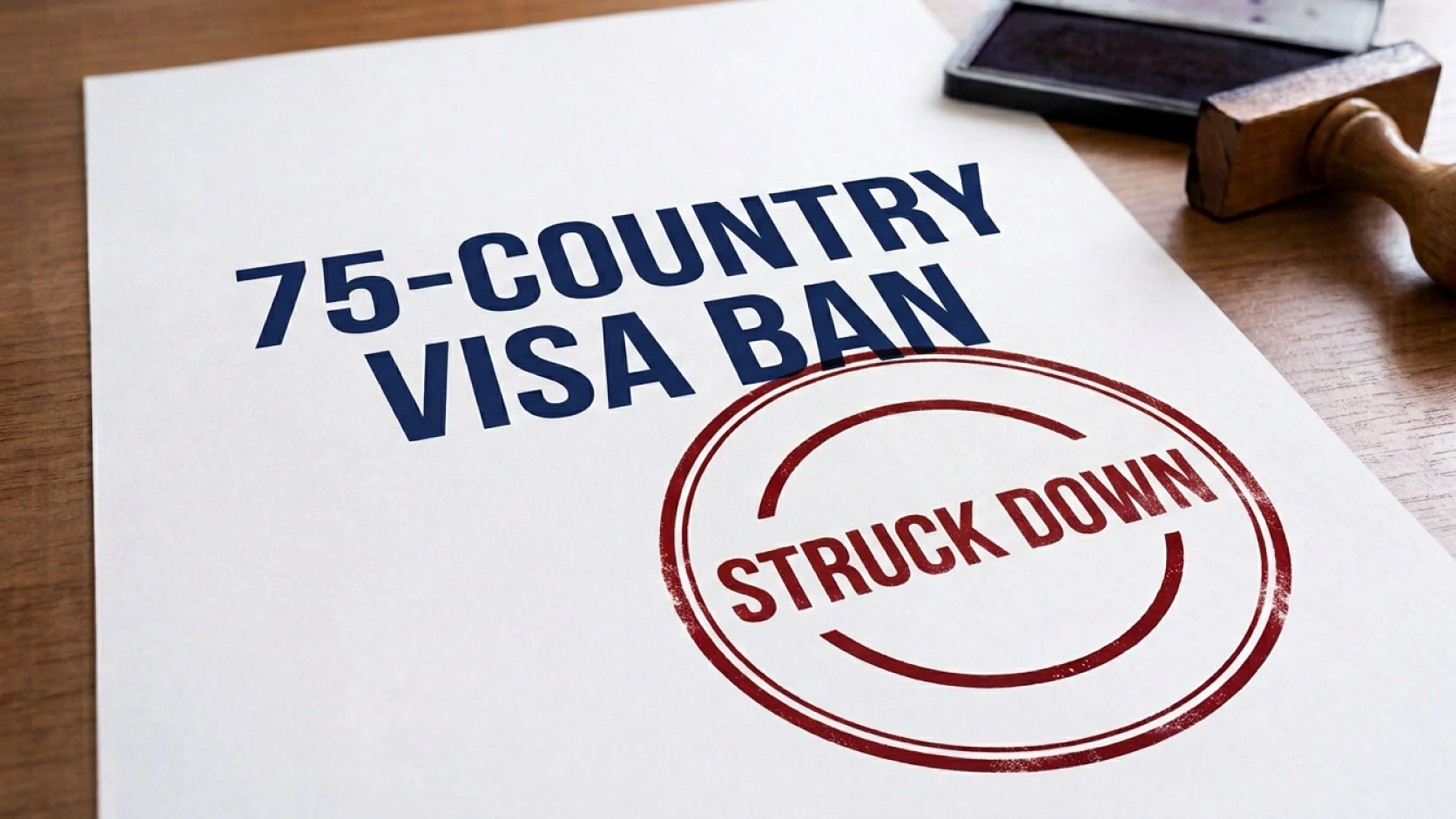
A federal judge in Manhattan ruled that the State Department broke the law when it froze immigrant visa processing for people from 75 countries. If you’re from one of those countries, this is good news. But there’s a catch: days after the ruling, the State Department paused immigrant visa appointments worldwide for “training.” Here’s what actually changed, and what hasn’t.
What Was the 75-Country Visa Ban?
In January 2026, the State Department quietly rolled out a big policy. It told U.S. embassies and consulates to stop issuing immigrant visas to people from 75 countries. That’s almost 40% of the countries on Earth.
This wasn’t a travel ban. It was narrower, but just as disruptive. It only hit immigrant visas, the kind that lead to a green card through family or a job. Tourist visas, student visas, and work visas weren’t touched.
The affected list included countries like Afghanistan, Brazil, Colombia, Egypt, Haiti, Iran, Russia, Somalia, and Yemen. If you were a national of one of these countries and applying for a green card from outside the U.S., your case could get stuck, no matter how strong it was.
The government’s reasoning? It said people from these countries were more likely to become a “public charge,” meaning dependent on government assistance. Officials pointed to data claiming that over 30% of households from these countries used some form of public benefit.
The problem: under this policy, it didn’t matter if you personally had a great job offer, savings, or a sponsor who could support you. If your passport was on the list, your case was frozen. No individual review. No exceptions.
This ban has some overlap with the USCIS freeze on 39 countries, a related but separate policy that froze cases already inside the U.S. If you’re trying to keep these straight, that’s normal. We’ll explain the difference below.
What the Judge Actually Decided
On August 21, 2026, U.S. District Judge Jeannette A. Vargas of the Southern District of New York struck the policy down. Her ruling was blunt.
She called the policy “contrary to law and in excess of statutory authority.” In plain English: the State Department did not have the power to do this.
Here’s her core reasoning. Federal immigration law gives individual consular officers, not the Secretary of State, the authority to decide whether someone qualifies for a visa. That decision has to be based on the specific person’s situation. Vargas found the 75-country policy skipped that step entirely.
“The Policy, which categorically prohibits the issuance of immigrant visas based upon the nationality of the applicant, represents a direct abrogation of this statutory scheme,” she wrote.
She also pointed to a basic anti-discrimination rule already written into immigration law: no one can be denied a visa just because of their nationality. The 75-country policy did exactly that.
Her ruling did two important things: it vacated the policy itself, so the nationality-based ban is no longer in effect, and it set aside visa refusals that were based only on this policy. That means some people denied a visa purely because of where they’re from could get their case looked at again.
One limit: this ruling does not force officers to approve any visa. If you were denied for a separate legal reason, like inadmissibility, that denial stands. It only undoes refusals based solely on your nationality being on the list.
The case is Catholic Legal Immigration Network, Inc. (CLINIC) v. Rubio, Case No. 1:26-cv-00858, filed in February 2026 by CLINIC, African Communities Together, and 11 individual plaintiffs, including U.S. citizens trying to bring family members home. See the Lexology legal summary of Judge Vargas’s decision for more detail.
Who Filed the Case, and Why It Mattered to Them
This case wasn’t filed by a government agency or a big political group. It was filed by people who had been personally separated from their families.
CLINIC, a Catholic legal aid network, and African Communities Together, an advocacy group, brought the lawsuit alongside 11 individuals. Some were U.S. citizens petitioning for spouses, parents, or children stuck overseas. Others were the applicants themselves, waiting on visas they had already qualified for.
Anna Gallagher, CLINIC’s executive director, said the case was “about keeping families together,” noting that “the suspension of lawful visa processing across 75 countries separated spouses, parents, and children who were simply following the legal immigration process.”
Antionette Dozier, an attorney with the Western Center on Law & Poverty who represented CLINIC, said the ruling means “a return to fair, case-by-case review, and a chance to be reunited with their loved ones” for families from all 75 countries.
That’s the human side of this story. Behind the legal language, this case was about spouses who hadn’t seen each other in over a year, and parents waiting to finally bring their kids home.
Wait, Didn’t the State Department Just Pause Appointments Again?
Yes, and this is the part you really need to know.
Days after Judge Vargas struck down the 75-country ban, the State Department made a new move. On August 25, 2026, officials confirmed they had paused immigrant visa appointments worldwide. The stated reason: consular officers need “in-depth training” on how to screen for public charge risk.
This is a separate action from the 75-country ban. It applies globally, to every country, not just the original 75. If you have an immigrant visa interview scheduled at a U.S. consulate anywhere in the world, including family-based and employment-based cases, it may be affected.
People with interviews already on the books are getting cancellation notices. New dates haven’t been announced. The State Department hasn’t said how long the training will take.
Immigration lawyers are frustrated. Shev Dalal-Dheini of the American Immigration Lawyers Association put it simply: applicants “did what the government asked them to do,” including completing security vetting, only to now face another delay. She said “these roadblocks are just really playing with people’s lives.”
So here’s the honest picture: the 75-country ban is legally dead. But a new, broader pause is now affecting immigrant visa interviews everywhere. Winning in court didn’t mean your interview is guaranteed to happen on schedule.
What This Means for Your Case, Step by Step
Let’s break this down clearly, based on your situation.
- If you’re from one of the 75 countries and were denied a visa because of the ban: Your case should be reconsidered. The refusal based solely on your nationality has been set aside. Reach out to the consulate or your attorney to ask about next steps.
- If your case was pending, not yet denied: Officers should now be reviewing your application individually, not automatically holding it because of your passport.
- If you have an immigrant visa interview scheduled anywhere in the world right now: Check your status closely. The global training pause may reschedule your appointment, regardless of your nationality. Watch for a cancellation notice.
- If you’re confused about how this relates to the USCIS freeze on 39 countries: These are two different agencies and two different policies. The 75-country ban was run by the State Department and affects visas issued at consulates abroad. The USCIS freeze on 39 countries affects green card, asylum, and citizenship decisions for people already inside the U.S. Both have been struck down in court, in separate rulings, by separate judges.
- If you’re not sure what to do next: Don’t withdraw your application, and don’t make big decisions about travel or benefits without talking to an immigration attorney first. Rules are shifting fast right now.
What Happens Next
Judge Vargas gave both sides until September 11, 2026, to submit proposals on remaining issues in the case. The government could still appeal her ruling.
Meanwhile, the State Department hasn’t said when the global appointment pause will end. The administration has also signaled it may pursue broader public charge screening changes and, separately, has discussed possibly revoking visas already issued to some applicants and asylum seekers.
This is very much a moving situation. We’ll keep watching it and update this post as things change.
Sources
- ABC News — Judge strikes down Trump administration policy that suspended immigrant visas for 75 countries
- NPR — Federal judge strikes down Trump visa ban targeting 75 countries
- PBS NewsHour — Federal judge vacates Trump policy that suspended processing of immigration visas from 75 countries
- Boundless — Judge strikes down Trump administration’s 75-country immigrant visa ban
- Lexology — Federal Court Vacates State Department’s 75-Country Immigrant Visa Suspension
- The Washington Post — State Dept. pauses immigrant visa appointments worldwide, says staff need training
- CS Monitor — US pauses immigrant visa processing, spurring uncertainty, lawyers say
- Boundless — Immigrant Visa Appointments Paused Worldwide